

What size photo print do I need?
Not sure what size to print your photo? This guide covers every size from A5 to A0, with dimensions in cm and inches, resolution requirements, room-by-room recommendations, and tips for finding frames in Australia.
Print your photos
Museum-quality prints on Ilford paper, delivered Australia-wide from $29.
You have the photo. It looks great on your screen. Now you need to figure out what size to print it, and that is where most people get stuck.
Should you go A3 or A2? What even is A1 in centimetres? Will your image look sharp at that size, or will it come out blurry and pixelated? And once it is printed, will it actually fit the frame you bought at Kmart?
This guide answers all of that. We cover every print size we offer at Aussie Prints, from a compact A5 all the way up to a full A0, with the exact dimensions in centimetres and inches, the best use for each size, and how to check whether your photo has enough resolution before you order.
Our Print Sizes at a Glance
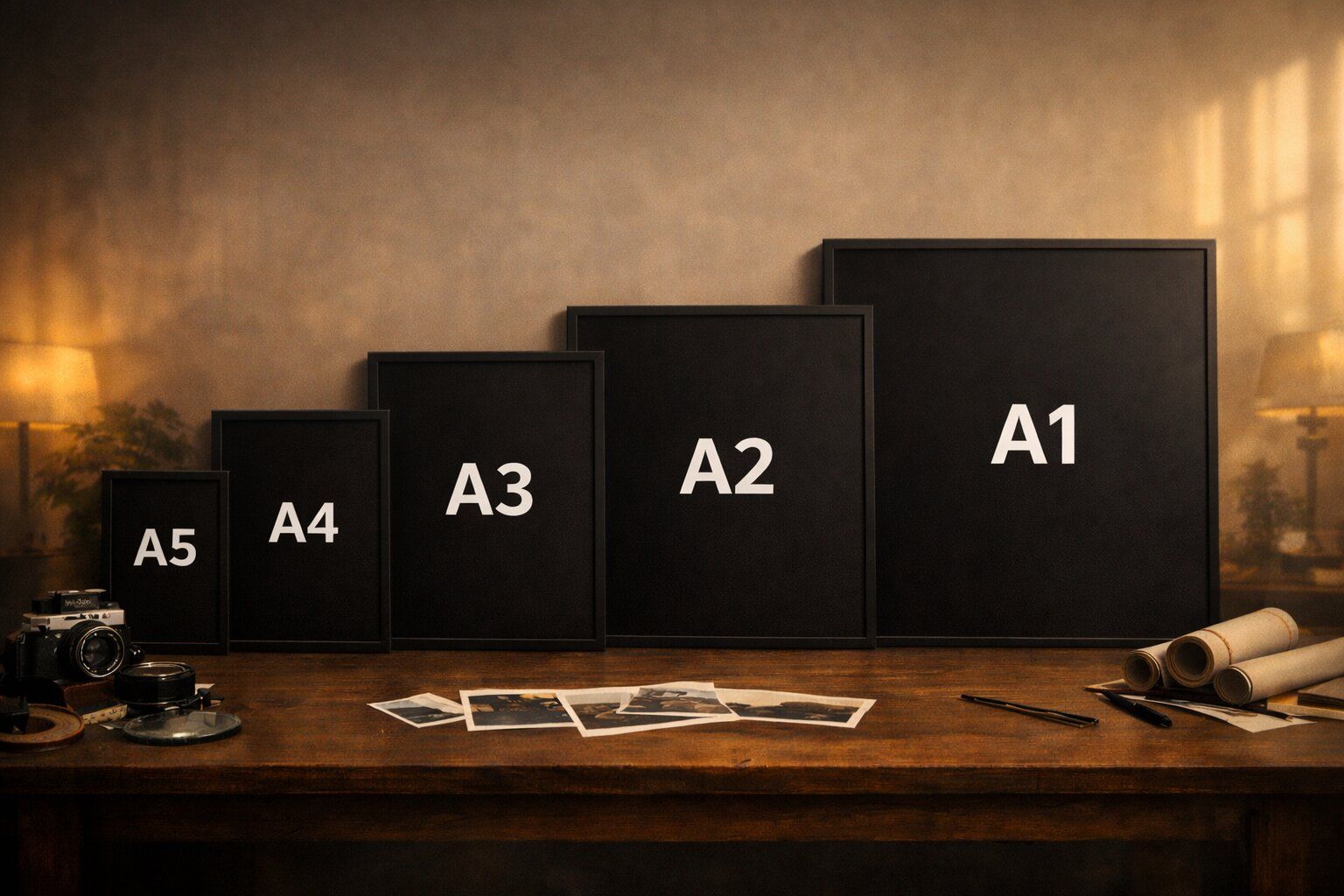
We print on standard A-series paper sizes, which are used across Australia and most of the world. Here is the full range, from smallest to largest.
A5: 148 x 210 mm (5.8 x 8.3 inches)
About the size of a paperback book. Great for desk prints, small gifts, or testing a paper type before committing to a larger format.
A4: 210 x 297 mm (8.3 x 11.7 inches)
The size of a standard sheet of paper. Works well for small framed prints, bedside tables, shelves, and compact gallery walls. A solid choice for portraits and detail-rich images you will view up close.
A3: 297 x 420 mm (11.7 x 16.5 inches)
Our most popular size for home wall art. Big enough to make an impact without dominating a room. A3 prints look fantastic on their own or as part of a gallery wall arrangement. This is the size we recommend if you are ordering your first print and are not sure where to start.
A2: 420 x 594 mm (16.5 x 23.4 inches)
A real statement piece. A2 works well above a sofa, a bed, or a dining table. At this size, your photo becomes a genuine focal point in the room. Great for landscapes, travel photography, and wide compositions.
A1: 594 x 841 mm (23.4 x 33.1 inches)
Large format. A1 prints are typically seen in galleries, offices, and living rooms with high ceilings. If you have the wall space, this size is incredibly striking. You will want a high-resolution image for the best results at A1.
A0: 841 x 1189 mm (33.1 x 46.8 inches)
Our largest size. A0 is nearly a metre wide and over a metre tall. It fills an entire wall and works best in large, open spaces. This is the format for panoramic landscapes, architectural photography, or any image where you want maximum visual impact.
Which print size for which room
Choosing a print size is not just about the image. It also depends on where you plan to hang or display it. Here are some practical guidelines based on the spaces we see most often.
Desk, Shelf, or Bedside Table
Go with A5 or A4. These sizes are designed to be viewed from an arm's length. They fit standard desk frames and small easel stands without overwhelming the surface. A4 is especially good for portrait photos, family shots, or a favourite travel memory you want to see every morning.
Hallway or Small Wall
A3 is your best bet. It has enough presence to draw the eye without taking over a narrow space. If you are creating a gallery wall with multiple prints, A3 combined with a couple of A4s is a classic combination that works in almost any home.
Living Room or Bedroom
A2 or A1. These rooms typically have more open wall space, and a single large print can anchor the whole room. A2 is the sweet spot for most living rooms. A1 is ideal if you have a feature wall or high ceilings.
Office, Studio, or Large Open Space
A1 or A0. Bigger rooms need bigger prints. A small photo on a large wall looks lost. In open-plan spaces, A0 prints create a genuine sense of presence. They are also popular for cafes, restaurants, and retail spaces.
How to Check if Your Photo is Sharp Enough
One of the biggest disappointments in photo printing is ordering a large print only to discover it comes out soft or pixelated. This happens when the image resolution is too low for the print size.
The general rule: you need at least 150 DPI (dots per inch) for a print viewed from a normal distance, and ideally 300 DPI for close-up viewing. Here is what that means in practice for each size.
A5 at 300 DPI: 1748 x 2480 pixels
A4 at 300 DPI: 2480 x 3508 pixels
A3 at 300 DPI: 3508 x 4960 pixels
A2 at 300 DPI: 4960 x 7016 pixels
A1 at 150 DPI: 3508 x 4960 pixels
A0 at 150 DPI: 4960 x 7016 pixels
For A1 and A0, 150 DPI is usually fine because you will be viewing the print from further away. Most modern smartphones shoot at 12 megapixels or higher, which gives you roughly 4000 x 3000 pixels. That is enough for a sharp A3 print at 300 DPI, or a great-looking A1 at 150 DPI.
How to Check on iPhone
Open the Photos app, select your image, tap the info button (the "i" icon), and look at the pixel dimensions. If you see something like 4032 x 3024, you are good for anything up to A2 at 300 DPI.
How to Check on Android
Open the image in your gallery app, tap the three-dot menu, and select "Details" or "Info". The resolution will be listed in pixels.
How to Check on Mac or PC
On Mac, right-click the file and select "Get Info". On Windows, right-click, go to "Properties", then the "Details" tab. Both will show the pixel dimensions.
Viewing distance: How far will you stand from the print?
This is an often overlooked factor when choosing a print size. The further you stand from a print, the larger it needs to be to have the same visual impact. It also means you can get away with lower resolution at larger sizes, because the extra distance hides imperfections.
Here is a rough guide for comfortable viewing distances.
A5 and A4: 30 to 60 cm (arm's length or closer)
A3: 60 cm to 1 metre
A2: 1 to 1.5 metres
A1: 1.5 to 2.5 metres
A0: 2 metres and beyond
If a print will hang at the end of a hallway or across a large room, go bigger than you think. One of the most common regrets we hear from customers is "I wish I had gone one size up."
Finding frames that fit in Australia
Because we print on standard A-series sizes, finding a ready-made frame is straightforward. A4, A3, and A2 frames are widely available at stores like Kmart, IKEA, Officeworks, and Spotlight. A1 and A0 frames are less common on the shelf but can be ordered online from most framing retailers.
A few things to keep in mind when buying a frame for your print.
Check the opening size, not the outer frame size.
Some frames are listed by their outside dimensions, which can be confusing. Always confirm the internal opening matches your print size.
Matboard borders change the frame size.
If your frame includes a matboard (the white border around the image), the frame itself will be larger than the print. For example, an A3 print with a matboard might sit inside an A2 frame. This is normal and often looks fantastic, as the white space gives the image room to breathe.
Consider going unframed.
Not every print needs a frame. Our heavier papers like Textured Cotton Rag (museum-grade) and Galicia Canvas (450gsm) look beautiful mounted or simply pinned to the wall with minimalist clips. It is a more modern, relaxed look that suits many homes.
Matching paper type to print size
The size you choose can also influence which paper works best. Here are some combinations we particularly like.
Small prints (A5, A4) on Smooth Pearl. The semi-gloss finish keeps colours vibrant even at smaller sizes where you will be viewing up close.
Medium prints (A3, A2) on Fine Art Textured Silk. At these sizes, the subtle texture of the paper becomes visible and adds a real sense of depth and quality.
Large prints (A1, A0) on Textured Cotton Rag.
Museum-grade cotton paper at large scale looks genuinely gallery-worthy. This is the combination professional photographers use for exhibitions.
Any size on Metallic Gloss.
Metallic paper creates a striking three-dimensional effect that works at every size. If your image features water, snow, or strong light, try it. You might be surprised.
Large statement pieces on Galicia Canvas.
The 450gsm canvas is built for big, bold displays. At A1 or A0, it transforms a photograph into something that feels more like a painting.
Not Sure? Start here
If this is your first time ordering a print and you are overthinking it, here is the simplest advice we can give.
Go with A3 on Smooth Pearl.
A3 is big enough to look great on a wall, small enough to fit almost anywhere, affordable enough to experiment with, and compatible with frames you can pick up at any homeware store in Australia. Smooth Pearl handles every type of image well, from bold landscapes to soft portraits.
Once you see that first print on your wall, you will know exactly what you want for the next one.
Ready to print? Upload your photo and choose your size. We print and ship from Melbourne to anywhere in Australia.