

The Equipment Paradox: Why Technical Mastery Outperforms Gear Upgrades
Better gear rarely produces better photos. Discover the three disciplines that actually transform your photography—and why mastering fundamentals beats upgrades.
Print your photos
Museum-quality prints on Ilford paper, delivered Australia-wide from $29.
There's a persistent belief in photography that better equipment produces better images. This assumption drives billions in annual camera sales—yet the correlation between gear investment and image quality is far weaker than most photographers realize.
After fifteen years of shooting professionally and studying the work of acclaimed photographers across genres, I've reached a counterintuitive conclusion: equipment upgrades rarely solve the problems photographers think they solve.
The Diminishing Returns of Modern Camera Technology
Contemporary camera technology has reached a remarkable plateau. A mid-range mirrorless body from 2020 captures more detail, handles low light better, and focuses faster than professional flagship cameras from a decade ago. The technical ceiling has risen so high that most photographers will never encounter it.
Yet the upgrade cycle continues. Photographers invest thousands in marginal improvements—slightly better dynamic range, incrementally faster burst rates, modest resolution increases—while the fundamentals that actually determine image quality remain unchanged.
The question worth asking isn't "what should I buy next?" but rather "what's actually limiting my current work?"
For the vast majority of photographers, the answer has nothing to do with equipment.
Three Disciplines That Transform Results
Extensive analysis of my own progression, combined with observations from working alongside photographers at various skill levels, has identified three disciplines that consistently separate compelling work from forgettable images.
Intentional Study of Light
Light is the raw material of photography. Its quality, direction, color, and intensity shape every image—yet most photographers treat it as a given rather than a variable to master.
Professional cinematographers spend years developing light literacy. They can articulate precisely why a scene works or fails based on lighting alone. This same discipline, applied to still photography, yields dramatic improvements.
The practice is straightforward: photograph a single location repeatedly across different times, weather conditions, and seasons. Document what works and why. Build a mental library of lighting scenarios. This accumulated knowledge compounds over years, informing every future shooting decision.
Development of a Post-Processing Philosophy
Digital capture records data. Post-processing transforms that data into a photograph that reflects the photographer's interpretation of the scene.
This isn't manipulation—it's the completion of the creative process. Ansel Adams spent as much time in the darkroom as in the field, and his zone system was essentially a framework for pre-visualizing the final print during capture.
Modern tools offer unprecedented control over this transformation. The photographers who leverage this most effectively aren't those with the most advanced software, but those who've developed a coherent visual philosophy: a consistent approach to tone, contrast, color, and detail that becomes recognizable across their body of work.
This signature emerges through deliberate practice: processing hundreds of images, studying the work of photographers and painters whose aesthetic resonates, and iterating until a personal style crystallizes.
Systematic Self-Assessment
Improvement requires honest evaluation of current work against aspirational standards. This is uncomfortable. Most photographers avoid it, preferring the validation of likes and comments over the clarity of genuine critique.
Effective self-assessment follows a structured approach: select your strongest recent images, compare them directly against work you admire in the same genre, and identify specific, addressable gaps. These gaps become your development priorities.
The key word is "specific." Vague observations like "their photos are better" provide no actionable direction. Precise observations like "their compositions use negative space more effectively to direct attention" point toward concrete skills to develop.
The Baseline Equipment Requirement
None of this suggests equipment is irrelevant. A minimum threshold exists, below which technical limitations genuinely constrain creative possibilities.
That threshold is lower than most assume. The essential requirements for serious landscape and travel photography are surprisingly modest:
RAW capture capability preserves maximum tonal and color information for post-processing. Any interchangeable lens camera manufactured in the past eight years meets this requirement.
Manual exposure control enables intentional creative decisions about depth of field, motion rendering, and exposure balance. Again, this is standard across all serious cameras.
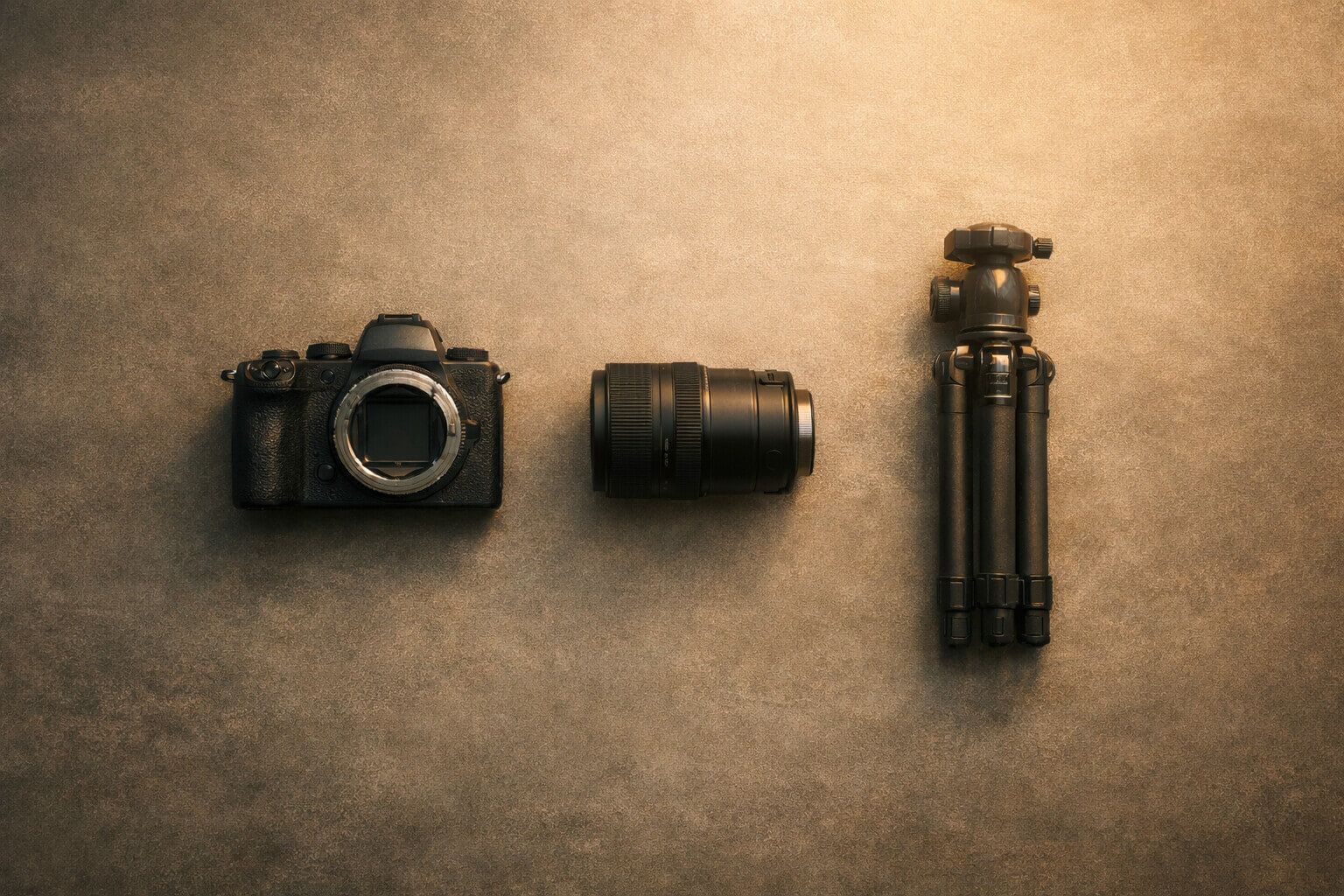
A quality tripod with sufficient stability for long exposures and precise framing. This is the one area where investment directly impacts results—cheap tripods introduce vibration and frustration in equal measure.
Beyond these fundamentals, additional equipment serves specialized purposes. A faster lens enables specific low-light or shallow depth-of-field techniques. Filters allow long exposures in bright conditions. A lighter body reduces fatigue on extended shoots.
Each addition should address a documented limitation in current work. "This would be nice to have" is not the same as "this solves a specific problem I consistently encounter."
The Compound Effect of Deliberate Practice
The photographers whose work commands attention share a common characteristic: they've invested disproportionately in skill development relative to gear acquisition.
This investment takes time. Light literacy develops over years of attentive observation. A distinctive processing style emerges through thousands of iterations. The ability to see and capture decisive moments improves incrementally through tens of thousands of frames.
Equipment provides capability. Skill determines whether that capability translates into compelling images.
A photographer with deep understanding of light, a refined processing approach, and disciplined compositional instincts will produce remarkable work with modest equipment. The reverse—expensive gear in untrained hands—produces technically adequate but visually unremarkable results.
The industry doesn't emphasize this because there's no margin in telling photographers to practice more. But the evidence is clear: the path to better photography runs through deliberate skill development, not retail transactions.
Practical Application
For photographers serious about improvement, consider this framework:
Before any equipment purchase, articulate the specific limitation you're addressing. If you cannot identify a concrete, recurring problem that new gear would solve, the purchase is premature.
Allocate resources toward education with the same intentionality applied to gear decisions. Workshops, books, and structured courses accelerate development in ways that equipment never will.
Implement constraints deliberately. Shooting with a single focal length for an extended period forces creative problem-solving and deepens understanding of that perspective.
Build a regular practice of comparative self-assessment. Quarterly review of recent work against defined benchmarks reveals progress and surfaces new development priorities.
The goal isn't to avoid equipment entirely—it's to ensure that gear decisions serve creative development rather than substituting for it.
The most impactful upgrade available to most photographers costs nothing: a commitment to mastering what they already own before acquiring what they don't yet need.almost irrelevant.
Photography is no different.
An Experiment in Constraints
Three years ago, I decided to test this theory. I committed to shooting exclusively with a single 35mm lens for twelve months. No zooms. No specialty glass. Just one focal length and whatever creativity I could muster.
The first two months were frustrating. I missed shots because I couldn't zoom in. Compositions felt repetitive. I questioned the experiment constantly.
By month four, something shifted. Instead of wishing for a different lens, I started moving. Physically repositioning. Thinking about scenes differently before raising the camera. I began seeing in 35mm—anticipating what would fit in the frame before looking through the viewfinder.
The constraint became a teacher.
My keeper rate tripled. Not because the images were technically superior, but because I was making deliberate choices instead of relying on equipment flexibility as a crutch.
What Actually Moves the Needle
After years of trial and error, and countless conversations with photographers whose work I admire, I've identified three factors that genuinely improve photography. None of them require new equipment.
Understanding light
This sounds obvious until you realize how few photographers study it intentionally. Light isn't just about golden hour—it's about quality, direction, color temperature, and how these elements interact with your subject. Spend a month photographing the same location at different times of day. You'll learn more than any YouTube review could teach you.
Developing a post-processing signature
The camera captures raw data. Post-processing transforms that data into your interpretation of the scene. This isn't cheating—it's the digital equivalent of what Ansel Adams did in the darkroom for decades. Every memorable photographer has a recognizable editing style. It takes time to develop, but it's far more distinctive than any equipment choice.
Ruthless self-critique
Most of us are too generous with our own work. We keep images because of the memory attached, not the image itself. Learning to separate emotional attachment from visual quality is uncomfortable but essential. Compare your best work to photographers you admire. Where specifically does yours fall short? That gap is your curriculum.
The Minimum Viable Kit
If you're starting out or reconsidering your approach, here's what actually matters:
A camera that shoots RAW files. This preserves maximum data for post-processing. Any interchangeable lens camera from the past decade qualifies.
The ability to control aperture manually. Understanding depth of field is fundamental to intentional photography.
A stable tripod. Not for every shot, but for the situations that demand it—long exposures, precise compositions, or simply slowing down your process.
That's it. Everything else is optional until you hit specific, identifiable limitations in your work.
The Real Investment
The photographers I most respect share a common trait: they're obsessive about the craft, not the tools. They study composition theory. They analyze paintings and films for visual ideas. They shoot constantly, fail regularly, and iterate relentlessly.
This is the investment that compounds—knowledge and practice, not deprecating assets.
A $500 camera in skilled hands will outperform a $5,000 setup every time. The difference isn't talent. It's accumulated understanding of what makes an image work.
If you're considering upgrading your gear, ask yourself honestly: have you extracted everything possible from what you already own? Have you mastered the fundamentals? Can you articulate specifically what limitation the new equipment would solve?
If not, the money is better spent on workshops, books, or simply more time behind the camera you already have.
The best photograph you'll ever take won't come from your newest piece of equipment. It'll come from the moment when everything you've learned—about light, composition, timing, and post-processing—converges in a single frame.
No gear purchase can shortcut that journey.